

Explore Listing
The Gregorian calendar was adopted and the old Julian calendar abandoned by the ‘Calendar (New Style) Act 1750’ that received Royal Assent on 27 May 1751. It came into effect on 1 January 1752. The body of the Act included:
Montgomery issued a directive to 21st Army Group on 26 August that instructed his army commanders, Lieutenant-Generals Harry Crerar (First Canadian Army) and Miles Dempsey (Second British Army), to do three things:
- Destroy the German forces in the Pas de Calais area and Flanders
- Seize the important port of Antwerp (Belgium)
- Continue the advance towards the Ruhr region, Germany’s industrial heartland
The Advance in Flanders was from 18 August-6 September 1918, when the Second and Fifth Armies begin operations in the Lys Valley to recapture ground lost during the German Spring Offensive (Kaiserschlacht) in April 1918.
The 36th (Ulster) Division was in X Corps of General Plumerer's Second Army.
The Advance in Picardy began with the Battle of Amiens on 8 August 1918. This was the start of the 'Hundred Days Offensive' forcing the Germans out of France and beyond the Hindenburg Line; it was a rapid series of victories culminating in the Armistice of 11 November 1918.
The British Fourth Army's attack east of Amiens was later described By General Ludendorf as ‘the black day of the German Army’. The Advance in Picardy would include the Battle of Amiens 8 - 11 August 1918 and the Second Battles of the Somme, 23 August - 3 September 1918.
 Over the weekend 31 October - 2 November 2008 the towns and boroughs of Northern Ireland hosted a series of parades to mark the return of the 1st and 2nd Battalions of the The Royal Irish Regiment from Operation HERRICK 8.
The 3rd Madras (European) Regiment was raised for service in the East India Company in 1853 and was converted to become the 108th Regiment in 1861. It was linked under the 'localisation plan' of Cardwell's Army Reforms to the 27th Inniskillings in 1872. From 1853 to 1876, the 108th served in India until embarking, on 21 November 1876, for Portsmouth.
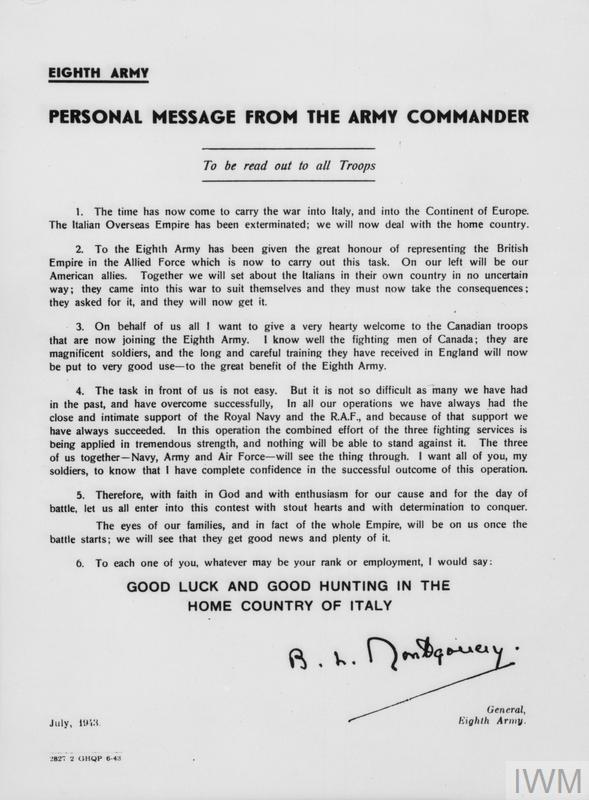
The Allied invasion of mainland Italy by General Alexander's 15th Army Group, comprising General Clark's Fifth ((US) Army and General Montgomery's Eighth Army, began when Montgomery launched his XIII Corps on Operation BAYTOWN on 3 September 1943, crossing from Sicily to Calabria on the toe of Italy. Operation AVALANCHE, the land invasion at Salerno by General Mark Clark's US Fifth Army (which included the UK's X Corps) and Operation SLAPSTICK, the 1st (UK) Airborne Division sea landing at Taranto and Brindisi, followed on 9 September.

On 8 November 1942, Operation TORCH landed Allied forces in Algeria (at Oran and Algiers) and Morocco (at Casablanca) to secure the Vichy territories of Morocco, Algeria and Tunisia. The intention was to advance to Tunis some 800 km to the east and then advance to attack the rear of the Axis forces fighting Montgomery's Eighth Army in the Western Desert. The overall strategic aim of the North Africa war theatre was to gain safe Mediterranean passage for Allied shipping and permit transit via the Suez canal instead of having to negotiate the longer passage via South Africa.
Opertion HUSKY was the Allied operation to invade and capture the island of Sicily. The invasion began on the night of 9/10 July and Sicily was finally captured when the last German forces were withdrawn on 17 August 1943.